Buyer guide
A combine header looks like simple cargo until you see what it costs to ship one. Sea freight is priced per container, so a single header carries all of it, and four headers sharing a box carry a quarter each. This guide is about reaching the second case without damaging a machine that is worth more than the saving.
Since 2013 Meridian Freight has shipped machinery from the United States and Canada: about 1,000 completed projects. More than 40 of those projects are combine headers: John Deere, Case IH, CLAAS and others, for farmers and for dealers who buy them in sets (see our header projects). In 2025 we prepared and dispatched 80 John Deere 930F headers in 20 containers for one Kazakhstan dealer, four to a container.
Why Headers Are Shipped in Sets
Ocean freight is quoted per container, whatever is inside it. With one header in a 40-foot box, that header pays for the whole sea leg. With four, each pays a quarter. We print no rate here, because it depends on the route and the week, but the division holds on any lane. What it leaves out is the work: four headers only fit one box after parts come off, a second level is built and everything is strapped, and a mistake in that work costs more than the freight you saved.
Many of the header projects in our archive are dealer purchases of three or four machines, packed together at our yard in Albion, Iowa and sent on to Ukraine or Kazakhstan. The 2025 program is the clearest example: 20 containers, 80 headers, a repeatable four-header arrangement and a standard route through New York to Klaipeda. Each container carried about 12 metric tons. How that four-header container was prepared has its own page.
Among the header projects in our records that name how the cargo was packed, almost all are containers: High Cube, standard or Open Top. The one exception is a draper on a flat rack.
Two Headers on One Trailer Before They Reach the Container
The saving can start before the port. A client who buys two headers from one seller is often offered two trucks, or one large specialised trailer. Many headers can instead travel one above the other on a single trailer, if the lower header's reel is in the transport position and the upper header rests on supports placed on parts of the lower frame that can carry it, never on the reel, its fingers, the hydraulic cylinders or thin panels. The two machines are tied to each other and separately to the trailer. Not every carrier has prepared such a load before.
In 2025 we bought two John Deere 930F Flex headers from a dealer in Indiana and moved them one above the other on one gooseneck trailer. That avoided a second trip and saved about $2,000 in first-mile transport to our yard, where the pair went into a 40-foot High Cube. In another 2025 plan one driver combined a pickup from a Nebraska farm with a pickup from a dealer, a detour of about 200 miles, on one gooseneck and saved about $1,500 (the Nebraska and Indiana collection plan).
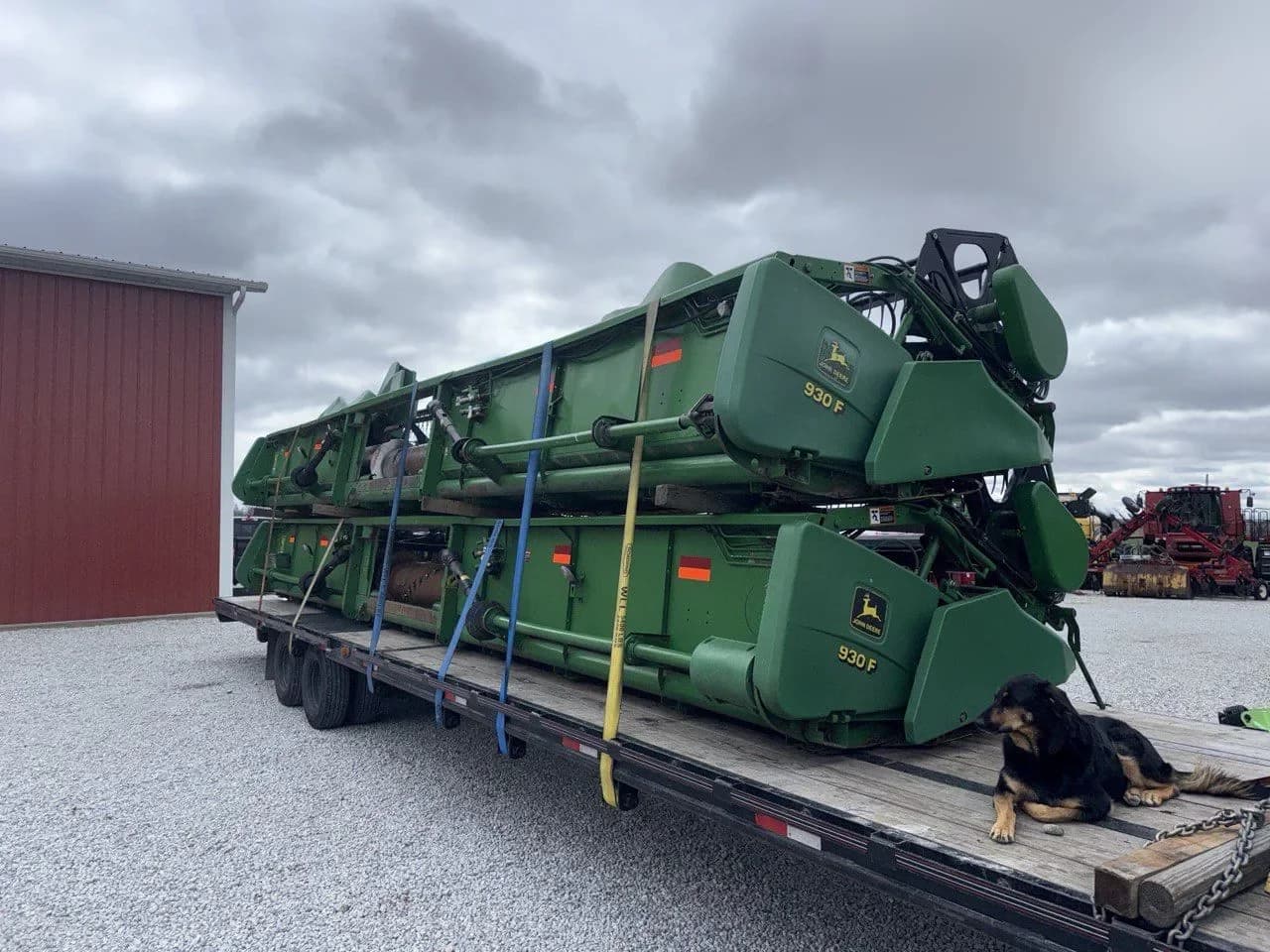
The supports and tie-downs are worked out per model. Ask your carrier for the rating and the driver licence class that apply to the whole combination at its actual weight, and do not assume a lighter trailer avoids the requirement.
Loading Four Headers Into a 40-Foot High Cube
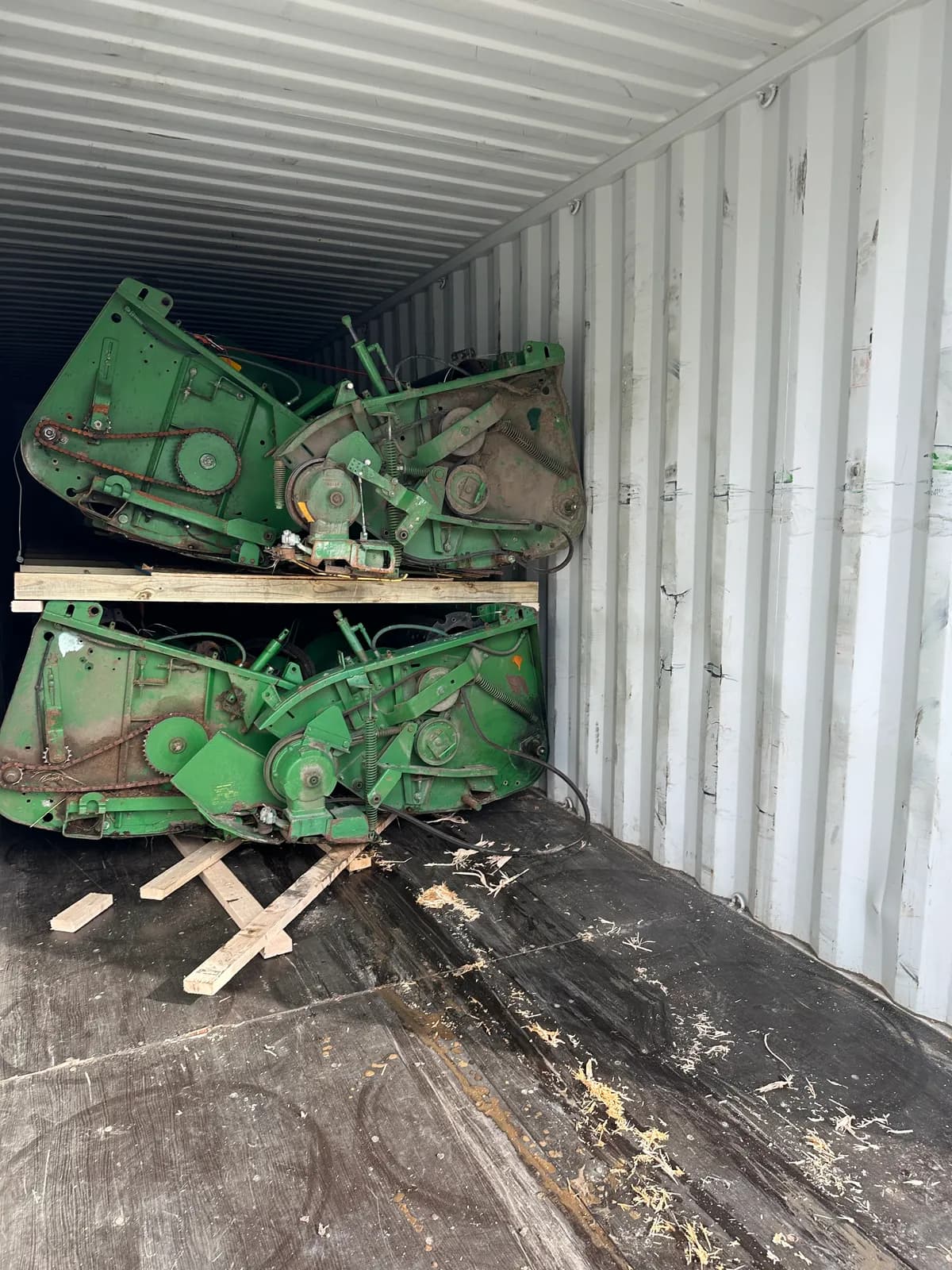
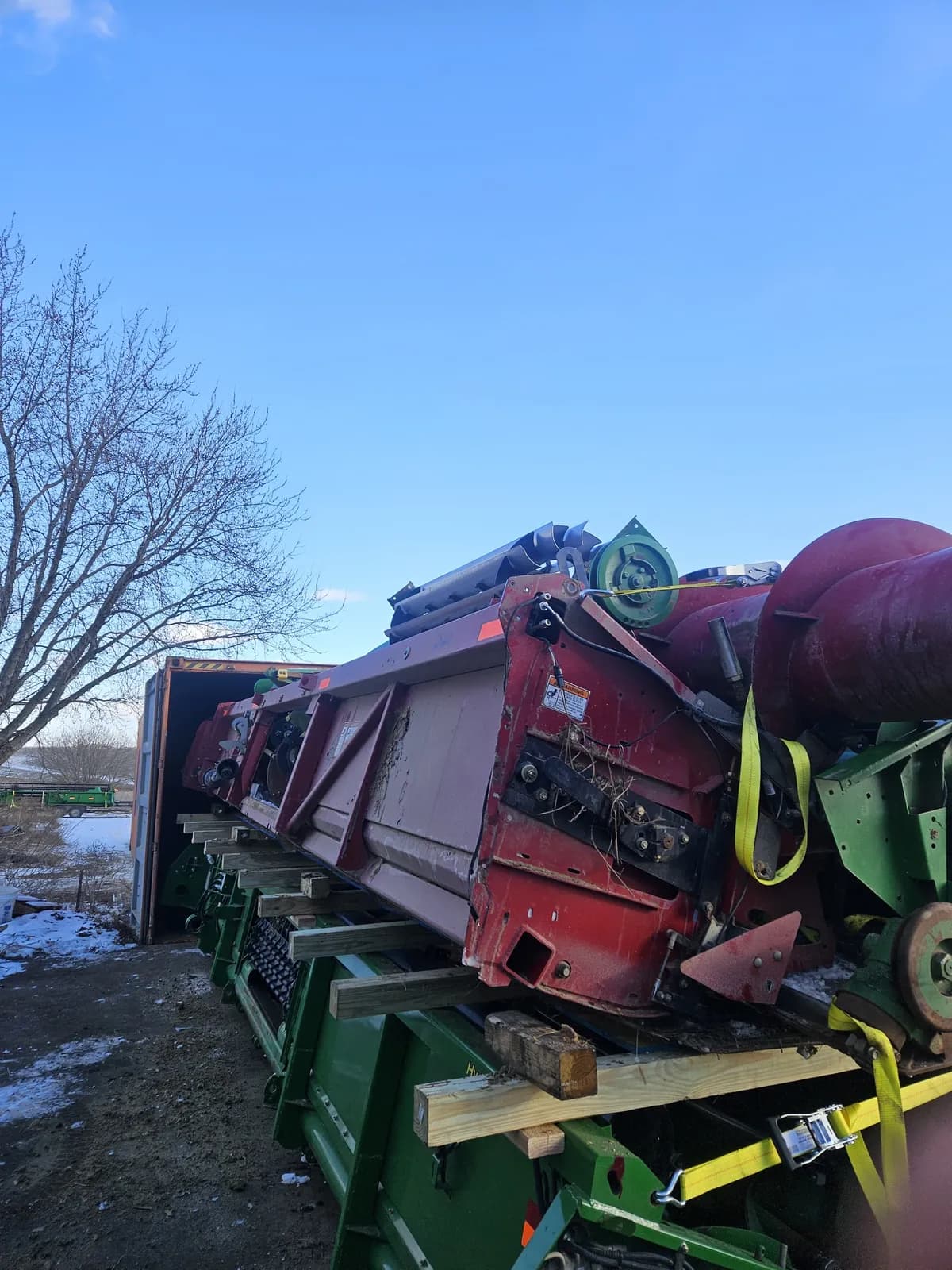
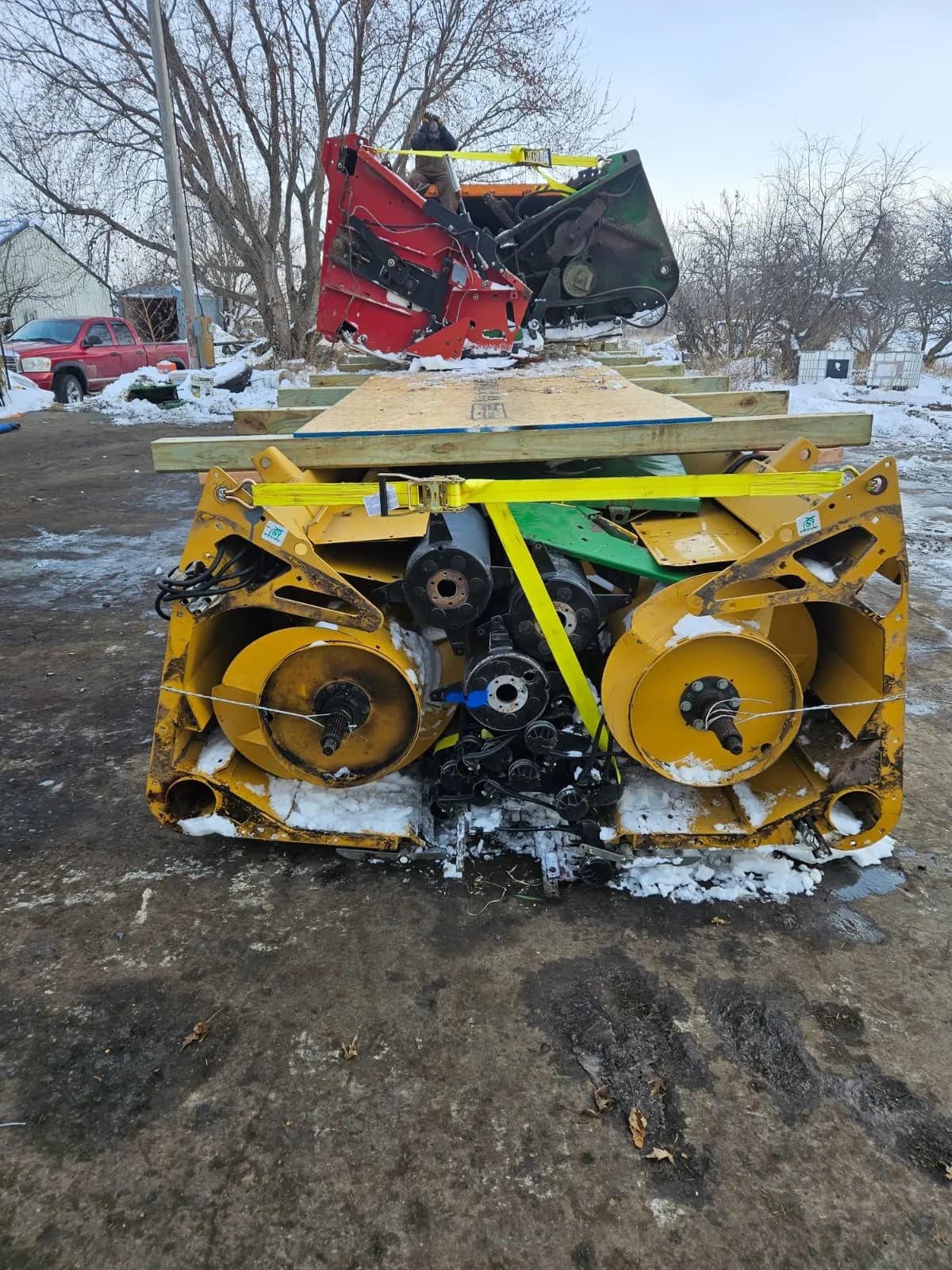
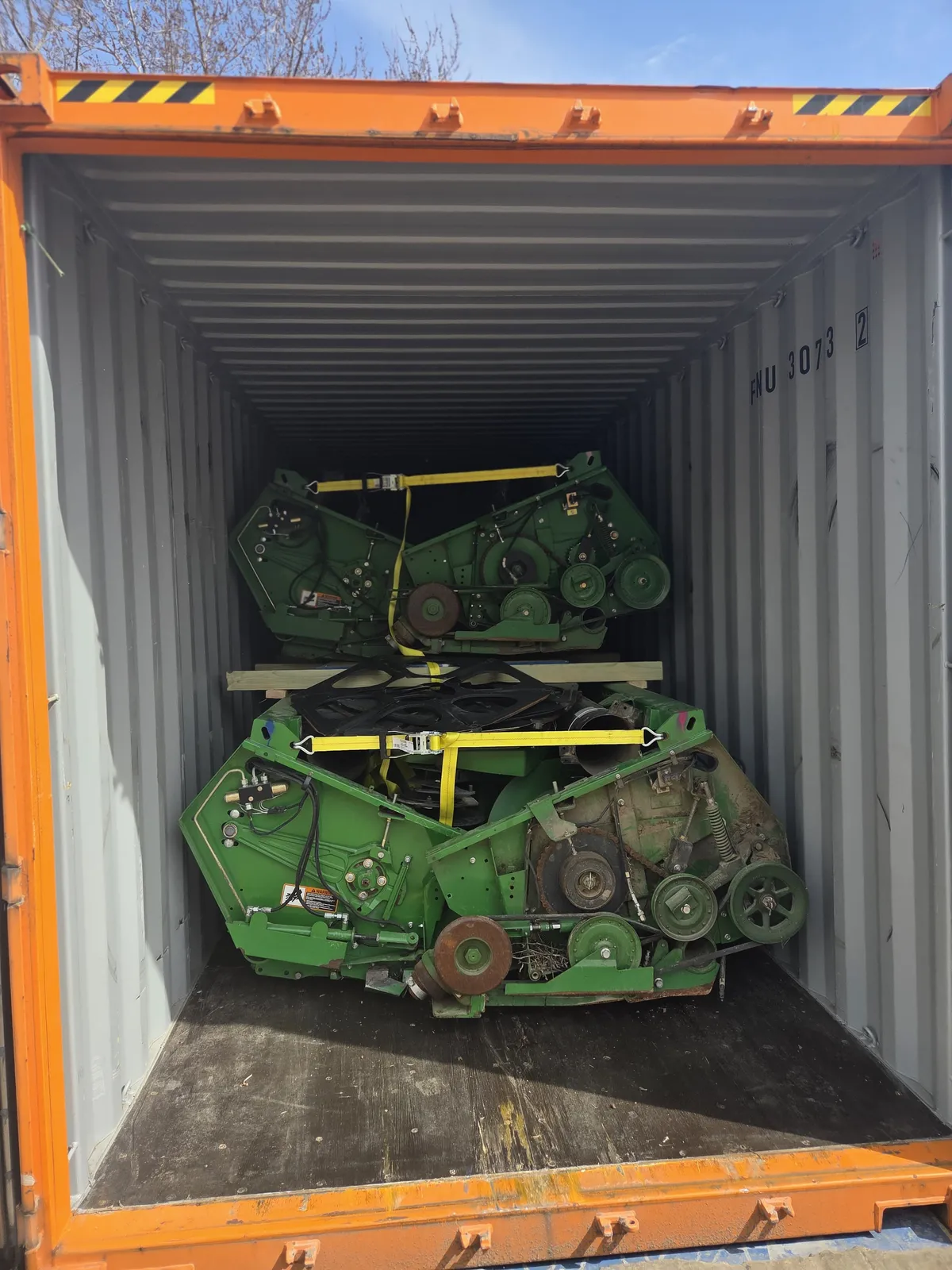
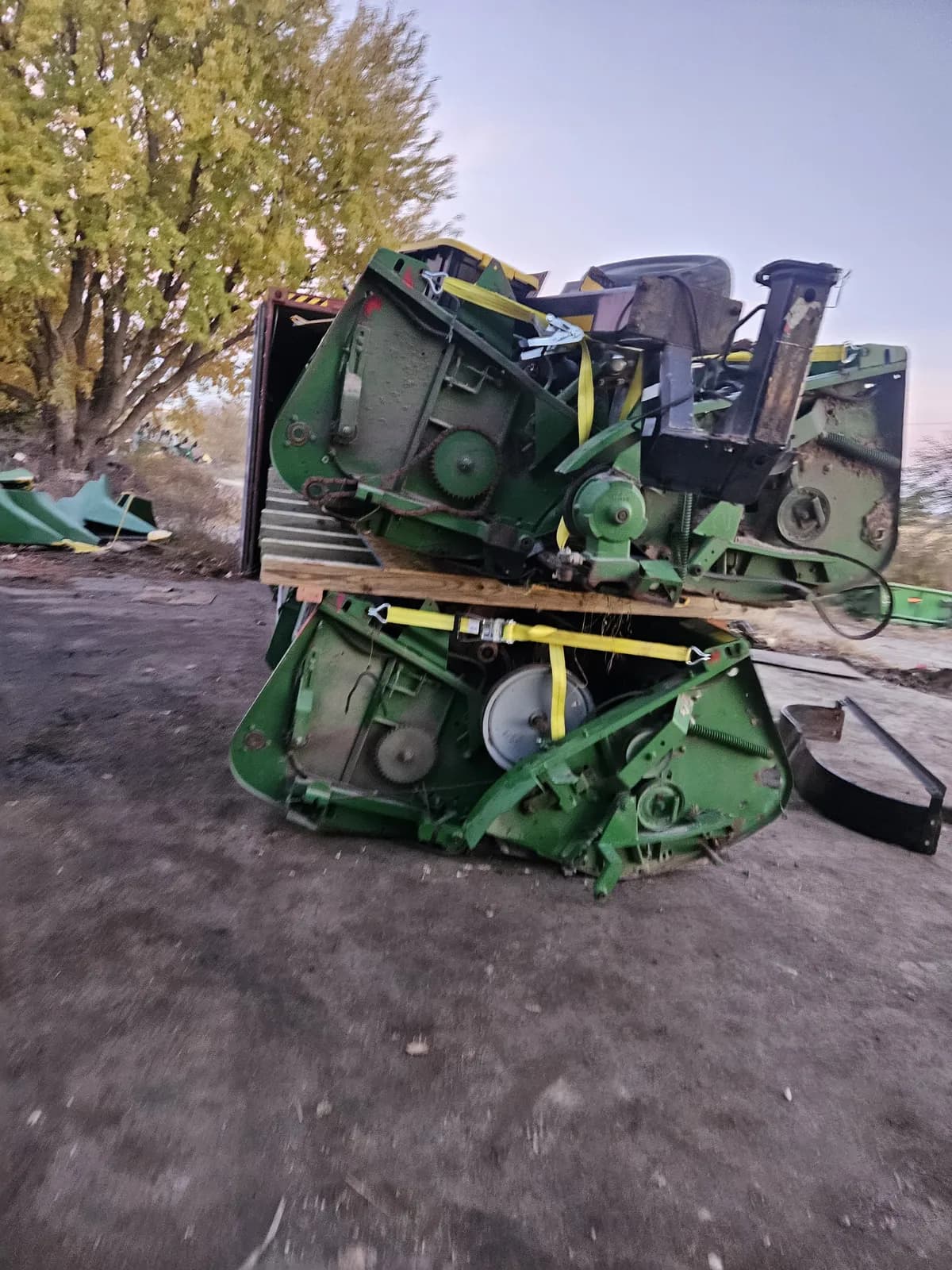
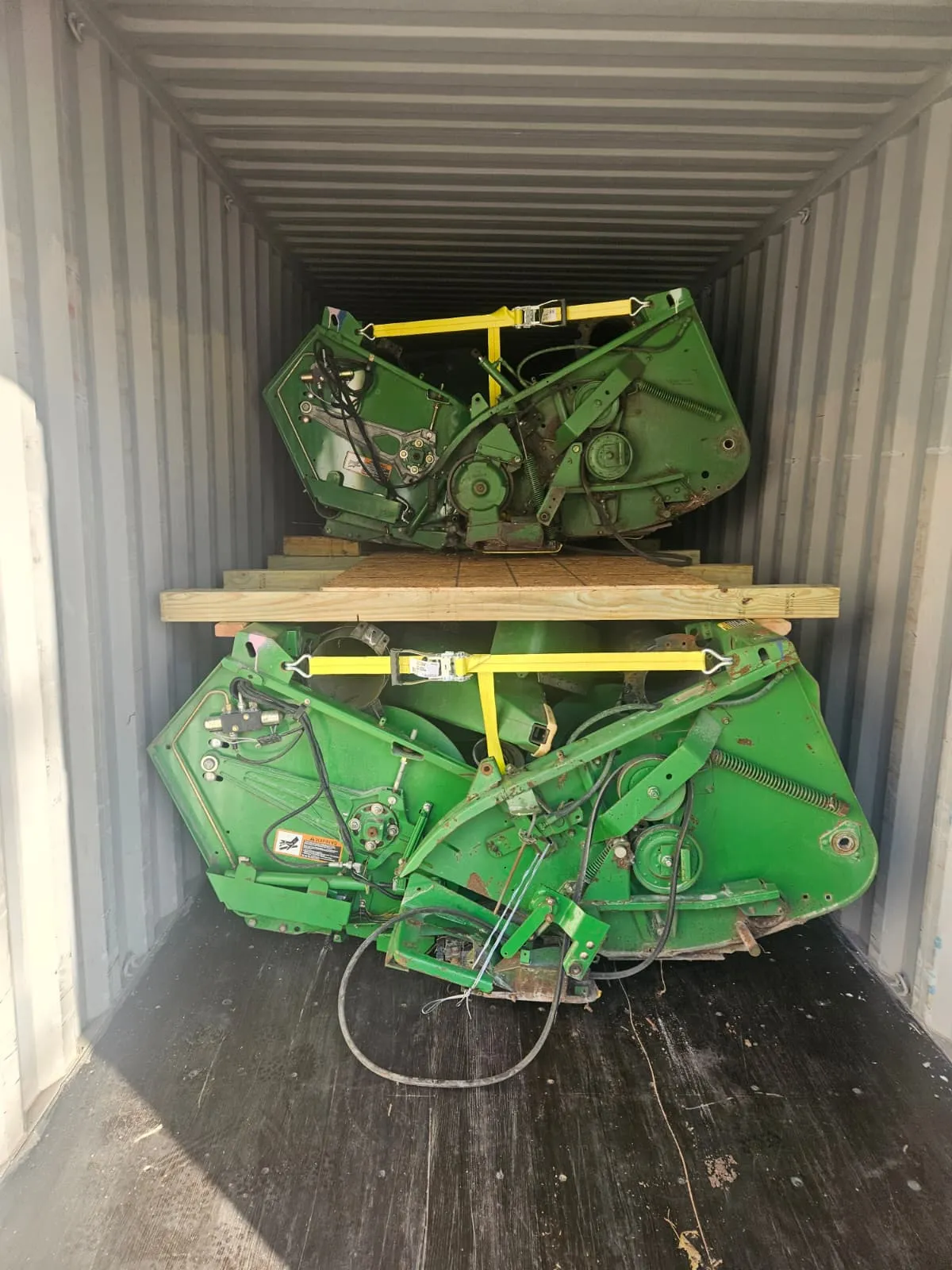
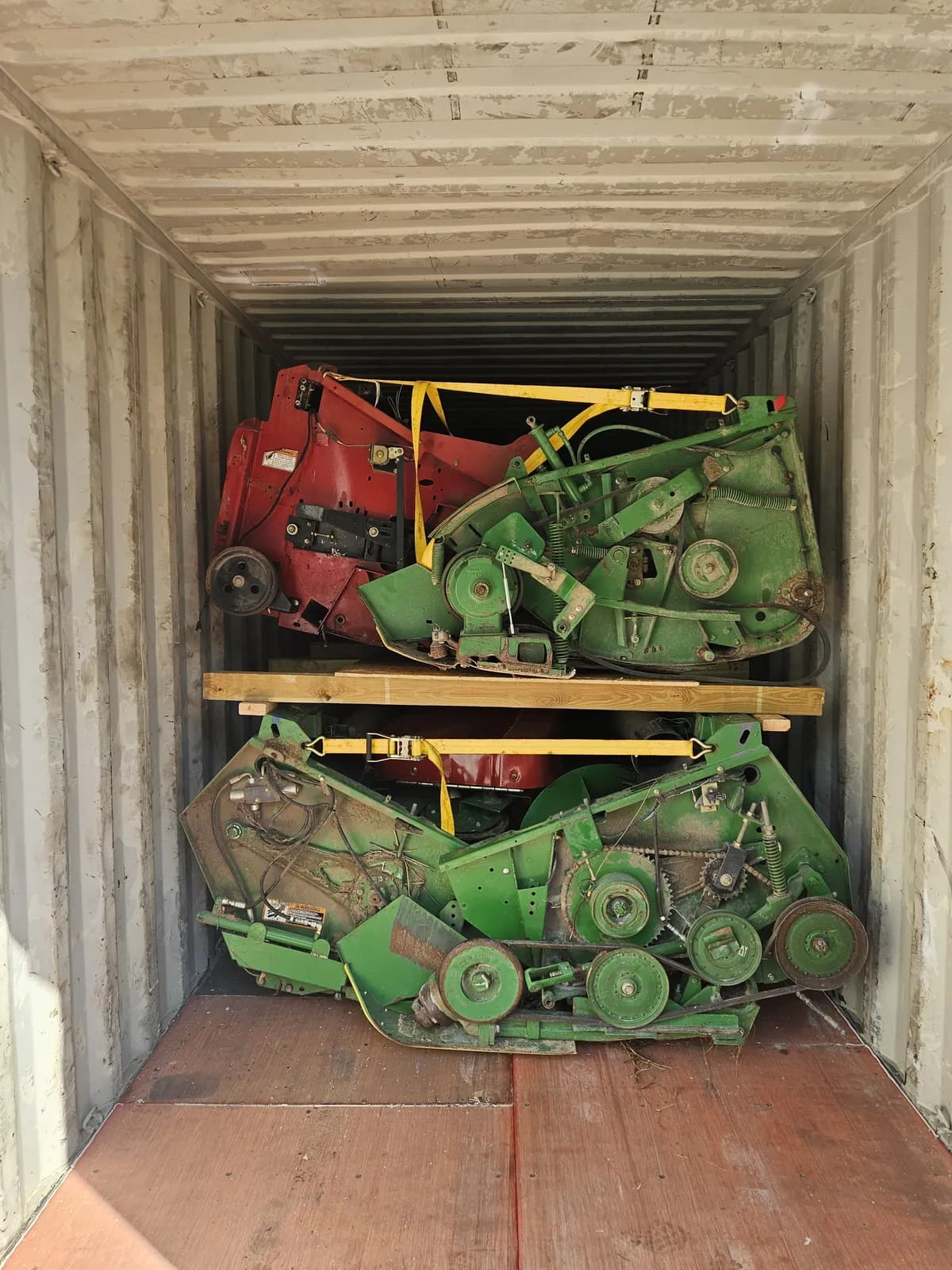
The usual container load is four headers on two levels: two nested one inside the other on the floor, and two more on a deck built above them. It is the arrangement behind four John Deere Flex headers loaded on two levels and four headers, including CLAAS, a Case IH 2020 and a John Deere 925F, in one High Cube. Our records include the John Deere 630F, 635F, 925F and 930F, the Case IH 2020 and the CLAAS 530 in loads like this.
1. Prepare the headers
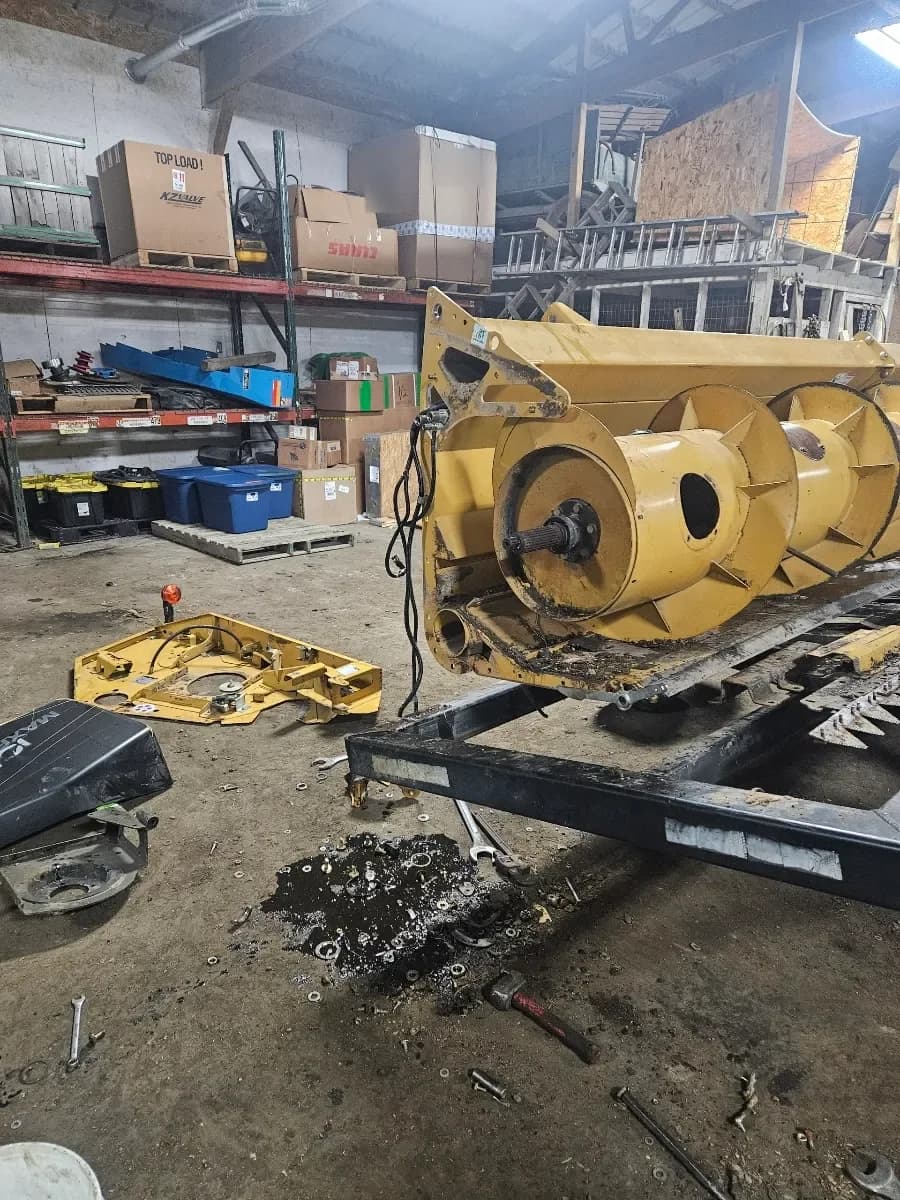
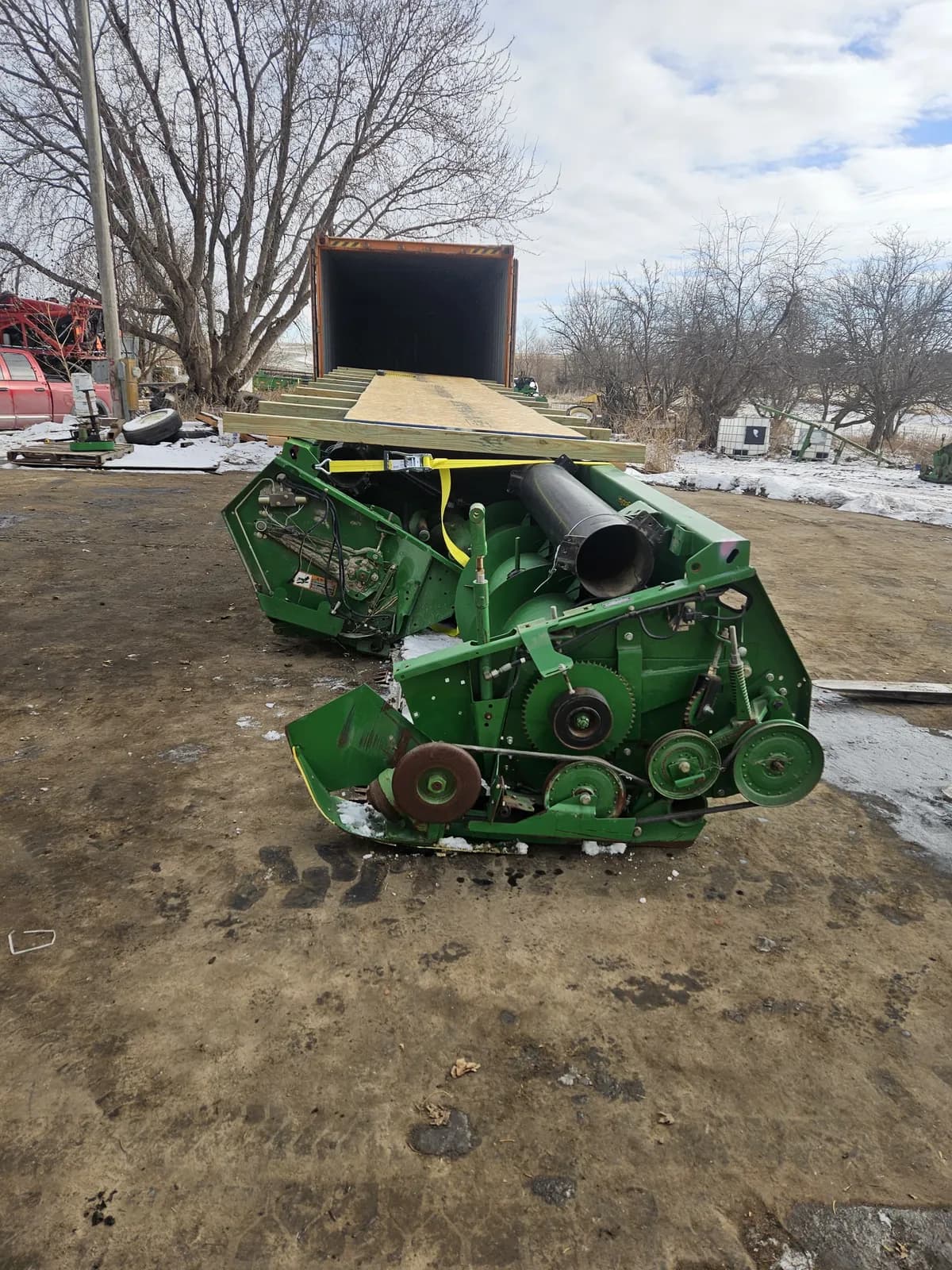
To nest one header inside another, the transport width has to come down and whatever blocks the nesting has to come off. On many models that means the side shields and a few brackets on one side of each header. Other models need much deeper disassembly: the CLAAS headers in the four-header CLAAS project took nearly two days of detailed work before the two lower headers could be nested. In the 2025 John Deere 930F program, four employees prepared four headers in about two days, and once the dismantled units were staged in loading order, placing and securing all four took about 30 minutes.
We remove only what really blocks the load, which keeps the work and the reassembly cheaper. Every removed part is labelled and travels with its machine.
2. Build the base
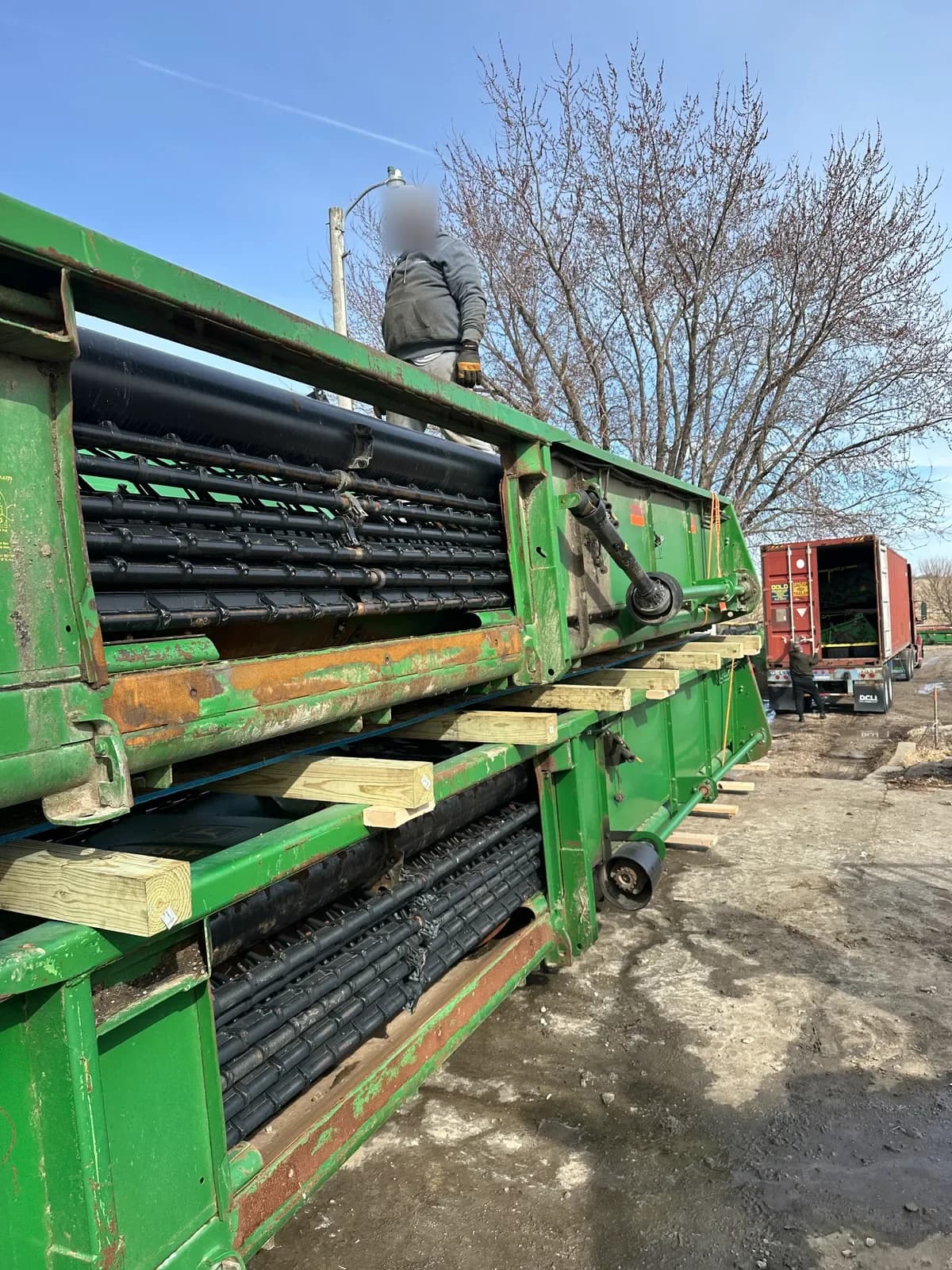
The end of the lower headers that goes into the container first sits on a timber base or skids. This makes the heavy block easier to move and keeps it off the container floor. We sometimes use OSB panels with timber guides, which works when the base is sized for the load and does not break up as it moves. The two lower headers are placed so that they overlap and take the least space.
3. Build the second level
A frame of timber beams goes across the lower headers and is covered with OSB panels to make one continuous deck. In the CLAAS project the deck was built from lumber and OSB above the lower tier, and the arrangement was designed so that the four machines could not shift toward one another. The deck has one job: to pass the weight of the upper pair into parts of the lower headers that can take it. Neither OSB nor timber is a universal answer; the size, spacing and bearing points of the beams are worked out for the model, not copied from the last job.
Two more headers, also nested in each other, then go on the deck. A telehandler is what makes this practical: it places long, heavy cargo accurately and reaches the upper level.
4. Use the gaps for the removed parts
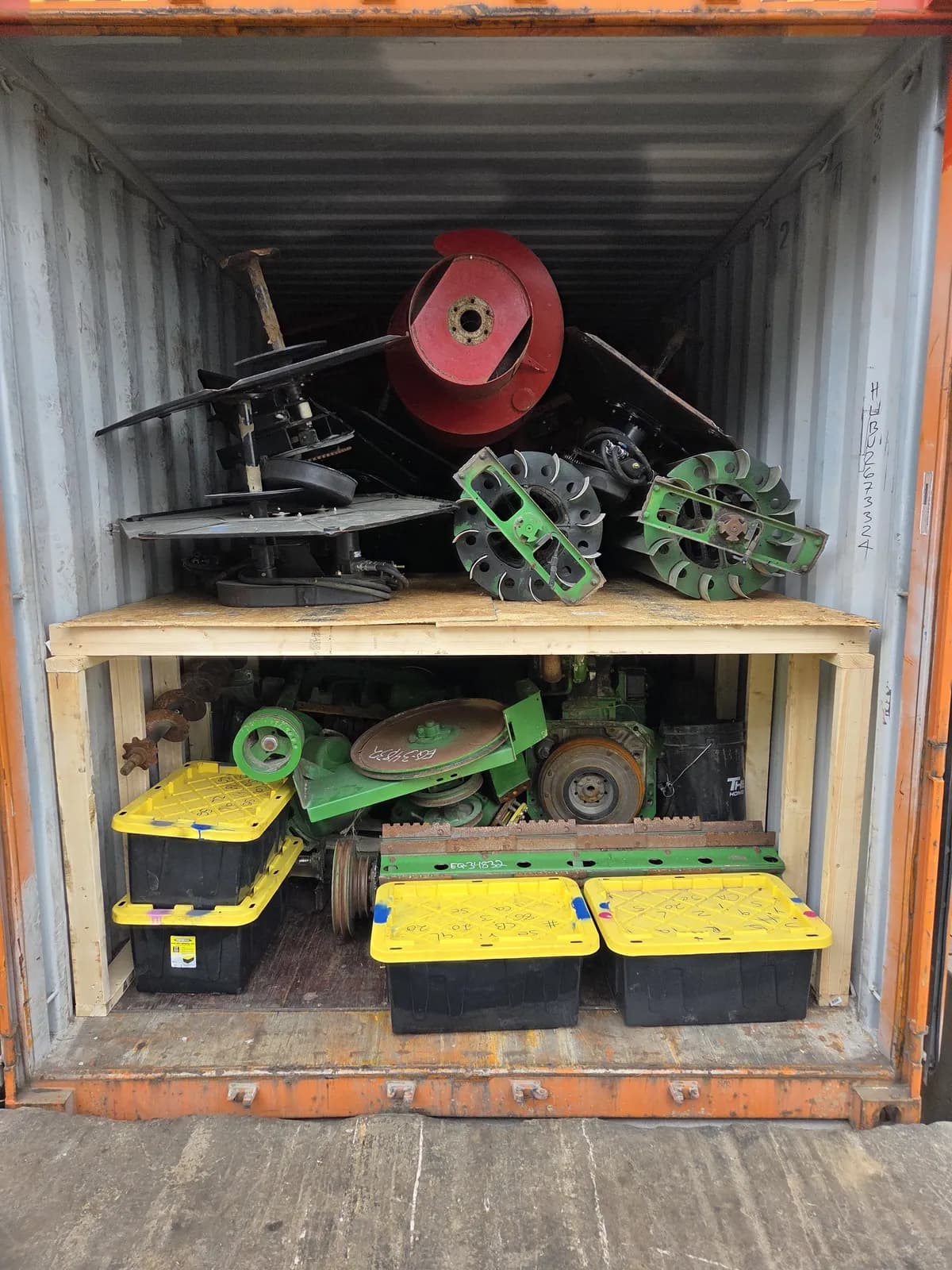
When the main machines are in place, small voids remain between the headers and inside the structure. Removed panels, brackets and fasteners are boxed and secured there and, if the client agrees, so are spare parts. Each item is packed or tied down so that it cannot hit the headers, and nothing placed there may get in the way of the lashing of the main load. In one load of three headers and spare parts we nested a 30-foot Case IH 2020 inside a John Deere 930F, built an upper deck for a John Deere 630F and put boxed spare parts in the voids; the equipment weighed about 10 metric tons.
5. Strap the load and secure it to the container
The lower and upper pairs are strapped to each other. We use industrial ratchet straps and single-use cargo-securing systems, which need metal seals and a tensioner; after tightening, the spare strap is cut off and the strapping is not reused. Tying the headers together is only half of the job. The whole block must also be secured to the container's lashing points with suitable straps, spacers and bracing, so that it cannot move forward, backward or sideways. Before the doors are closed the floor load, the weight distribution and the door clearance are checked. The carrier's rules apply, and the recognised reference for packing and securing cargo in containers is the IMO/ILO/UNECE CTU Code.
Three Mistakes That Damage Headers
Each of these looks minor on the day and shows up as damage at the other end. They are engineering principles, not a list of other companies' failures.
Mistake 1: The headers are not tied to each other
Nesting one header inside another is not enough. A moving container sends vibration and forward, backward and sideways loads through the cargo. Headers that are not tied together shift against each other, press on the container walls or damage their neighbours, and at the destination they can be hard to separate without further damage.
Mistake 2: Too few supports, or the wrong ones
A heavier timber is not a safer support. What counts is the geometry and number of the supports, the strength of the material, where the load really passes into the lower header and how firmly the upper tier is fixed. A few large beams placed too far apart push the weight of the upper headers, with every jolt of the road added, onto a few small areas of the lower frames, and a frame can bend under it. Supports must bear on the parts of the lower machine that are designed to carry load.
Mistake 3: The load is not secured to the container
Headers can be tied tightly together and still slide as one block. In road haulage, rail shunting and at sea, a block that is not secured to the container's lashing points can move as a whole. The packing has to join the machines to each other and the block to the container, and the method should follow the carrier's requirements and recognised guidance such as the CTU Code above.
Draper Headers Are a Different Problem
Rigid and flex headers nest into compact blocks. Draper headers are usually wider, and the frame, the belts and the drives limit how tightly they can be packed. Our planning rule for a draper is two to a 40-foot container, on two levels if the design allows it, and some large drapers will not fit even one without partial disassembly. Whether a draper's frame can be separated for transport is a question about the specific model, answered from the manufacturer's technical documentation, not by assuming that a series comes apart the same way.
Some drapers have a one-piece welded main frame, which ordinary disassembly cannot shorten. Cutting and re-welding a load-bearing frame is technically possible, but on an expensive modern header we do not recommend it without an engineering assessment and the owner's agreement, because it can change the platform's geometry, its performance and its resale value. For such headers we look at the other sea routes below.
One draper in our records, a John Deere HydraFlex of 3,800 kg, went to Ukraine on a 40-foot flat rack.
Open Top: When the Door Is the Problem
An Open Top container has a removable roof, so the cargo goes in from above with a crane instead of through the end doors. It suits loads that cannot be pushed in through the doors safely. Not every shipping line has Open Top boxes and not every terminal handles them, so we check availability on the route first.
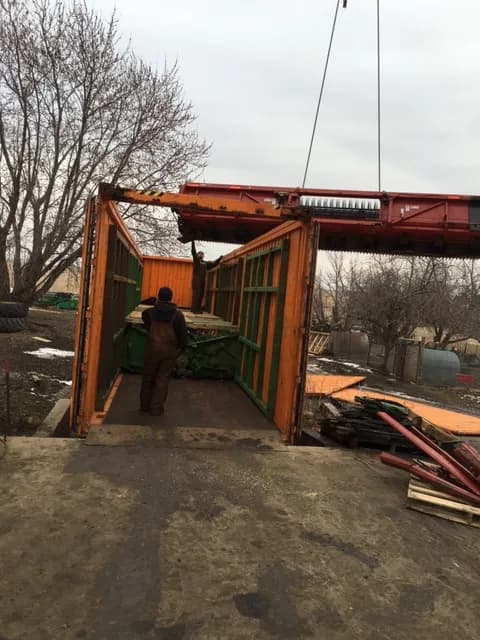
Two examples from our archive. In 2014 we loaded seven machines into one 40-foot Open Top container: four headers (a Case IH 2020 and two John Deere 925), two John Deere cultivators and a John Deere 7000 planter with a liquid fertilizer system, routed through Chicago and New York to Odesa. In 2026 we loaded four 25-foot headers with boxed parts and disc-harrow components into one 40-foot Open Top by crane.
Can a Long Header Go in a 45-Foot Container?
Sometimes. A 45-foot container has more interior length than a 40-foot one, which can be enough for a specific long header in its transport configuration. The first problem is logistics, not engineering: not every shipping line offers 45-foot containers on a given route, and a box that exists at one terminal may not be accepted to your destination port. Dimensions, permitted weight, loading conditions, the vessel and the onward delivery all have to be confirmed, so this option needs a separate availability check and the line's agreement before anything is planned around it.
Headers Too Long for a Container: MAFI and RoRo
A very wide draper of around 50 feet with a one-piece frame does not go into a 40-foot container, and a 45-foot box does not solve it. One practical option is a MAFI, a heavy port roll trailer used on RoRo (roll-on/roll-off) vessels: the cargo is secured on the platform and a port tractor takes it aboard over the vessel's ramp. That makes it possible to move equipment that cannot be packed in a standard container.
Several headers can share one platform only if a frame is engineered for them: dimensions, weight, centre of gravity, supports and securing are calculated and the design is agreed with the terminal and the RoRo carrier. How many machines fit depends on the machines and the platform, and the answer comes from the calculation, not from a rule of thumb. Where it works, one agreed load replaces several separate out-of-gauge cargoes.
Container, Open Top or RoRo: What Decides the Cost
The choice depends on the model, the frame, whether it can be taken apart, where the seller is, the destination port and whether a special container is available. In our records four to a 40-foot High Cube is the usual answer for rigid and flex headers, and our planning rule for drapers is two; Open Top, 45-foot boxes, MAFI and RoRo come in when a standard load does not fit.
Do not compare the ocean rate alone. Count the whole chain per header: collection from the seller, the trailer, disassembly, packing materials and supports, lifting equipment and crew, the sea leg, port handling and reassembly at the destination. The cheapest sea rate can sit on top of the most expensive chain. For the cost components see how much it costs to export a combine harvester, for the box types 40ft HC vs flat rack vs open top, and for a route estimate the freight cost calculator.
Meridian Freight's Experience
Since 2013 Meridian Freight has shipped agricultural and heavy machinery from the United States and Canada, about 1,000 completed projects. Our packing yard in Albion, Iowa receives, disassembles, prepares and loads the equipment (dismantling and container packing), and we work with individual farmers and with dealers who buy headers in sets.
No two header projects are the same: even one model differs in options, reel and frame condition. What matters is not only which container to book but how the machines are placed, which parts come off, where the supports go and how the load is secured. Sometimes changing the position of two headers is enough to avoid a second truck.
If you plan to buy John Deere, Case IH, CLAAS, MacDon, Honey Bee or other headers in the USA, send us the models, the number, where they are and the destination country, and we will work out the options for collection, preparation and shipping. See the headers we handle and our header projects, use the freight cost calculator, message us on WhatsApp or open the contact page.