Shipping Destinations
Ship Machinery to Chile
Meridian Freight (meridianexport.com) is a machinery export and freight forwarding company: we ship used agricultural and construction machinery from the USA and Canada to Chile, and we prepare the export documentation. We are the exporter, not a dealer: your Chilean customs agent files the import declaration. San Antonio serves Santiago and the central agricultural valley, and Puerto San Antonio says it handles 67% of the container market of Chile's central macrozone. Current carrier rates show 28-35 days from US ports to San Antonio and 40 days by 40HC from the Chicago rail ramp, port of loading to port of discharge.
Rated 5.0 on Google from 17 reviews of our Albion, Iowa packing facility, as of Nov 19, 2026Route Details
Recent shipment
We just shipped this route
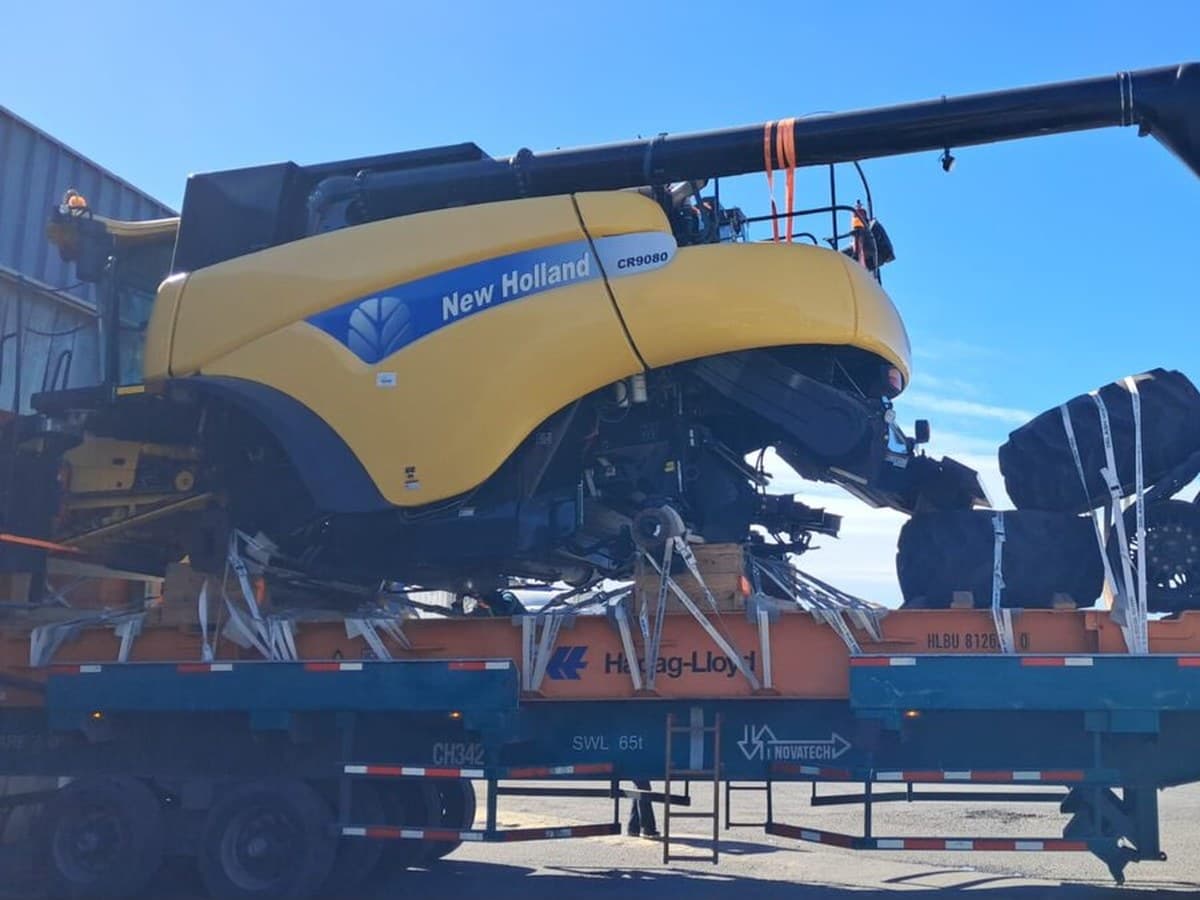
New Holland CR9080 - Track Removal Cut Inland Cost
This New Holland CR9080 combine travelled with its tracks removed and carried on the same trailer, then went by 40 ft Flat Rack to Chile in 35 days.
- Titan Machinery - Houston - San Antonio, Chile
- 40ft Flat Rack
- 35 days
More projects on this route
Further shipments from our project archive to this destination.
 Combines
New Holland Tracked Combine - Fargo to San Antonio, Chile
This New Holland CR9080 combine travelled with its tracks removed and carried on the same trailer, then went by 40 ft Flat Rack to Chile in 35 days.
Read the full case studyJohn Deere Forestry Machine - Chile Export
A 1999 John Deere forestry machine bought in Alabama, moved by lowboy to Houston and shipped on a 40-foot Flat Rack to San Antonio, Chile, in about 40 days.
Read the full case studyCase studies
What Chile requires to import used farm machinery from the USA
SAG, Chile's agricultural and livestock service and its national plant-health authority, sets the phytosanitary requirements for the import, temporary admission and transit of used machinery in Resolución Exenta 3.103/2016 (SAG, normativa.sag.gob.cl, read November 17, 2026). The resolution defines used machinery as machinery, equipment, implements and their parts for agricultural, forestry, gardening and earthmoving use, waste compactors and anything else SAG determines according to the phytosanitary risk (article 2). Machinery entering Chile, imported or admitted temporarily, must arrive clean and free of soil, plant debris and regulated pests, which means cleaning it inside and out in the country of origin by pressure washing, steam, forced air, vacuuming or another suitable method, dismantling parts if necessary (article 3).
SAG inspectors check every shipment on arrival at the point of entry, a physical verification of the phytosanitary requirements. If the inspection finds non-compliance or pests that are not regulated, SAG applies phytosanitary risk-management measures in proportion to the risk it identifies (article 7). The importer is responsible for meeting the requirements, for the cost of the measures SAG determines when they are not met, and for re-shipping rejected machinery within the deadlines SAG sets (article 5). Admission is therefore SAG's decision at the point of entry, not Meridian's, and the condition of the machine when it arrives is what counts (Resolución Exenta 3.103/2016, SAG, read November 17, 2026).
Packing wood and dunnage must meet the specific phytosanitary regulations for entering the country (article 6 of Resolución Exenta 3.103/2016). SAG's wood packaging page states that the wood packaging used to carry any shipment arriving from abroad or in transit must comply with ISPM 15, the international standard for wood packaging in international trade, and cites Resolución 133 of 2005 as amended by Resoluciones 2.859 of 2007, 7.008 of 2013 and 4.782 of 2023 (SAG, sag.gob.cl, read November 17, 2026).
Aduanas de Chile, the national customs service, says that when the FOB value of a commercial import is above US$1,000 the importer must hire a customs agent, and that the agent prepares the import declaration (Declaración de Ingreso) from the base documents the importer hands over (Aduanas de Chile, aduana.cl, page on what to do to import goods, read November 17, 2026). Four documents are mandatory for every commercial import: the original bill of lading, the original commercial invoice, the importer's sworn declaration of the price of the goods (a form the customs agent provides) and the mandate that authorizes the customs agent, which is given simply by endorsing the original bill of lading.
Other documents depend on the operation: a certificate of origin when the import claims a tariff preference under a trade agreement, a packing list (always for goods in containers), an insurance certificate when the premium is not on the invoice, an expense note when the expenses are not on the invoice, and permits, authorizations, certifications or approvals (vistos buenos) where they apply (Aduanas de Chile, same page, read November 17, 2026). Aduanas de Chile's glossary defines a customs agent (agente de aduana) as an auxiliary professional of the customs function whose license lets them act before Customs for third parties in the clearance of goods, and a despachador de aduana as the customs agents plus the consignors or consignees licensed to clear goods (aduana.cl, general norms, read November 17, 2026).
Meridian Freight prepares the US and Canada side: pickup, dismantling when needed, packing, export documents and the freight booking to the agreed port. The customs agent you hire in Chile files the import declaration, and confirms the tariff heading, the duties and taxes, and the SAG coordination for your machine; port charges and inland delivery in Chile are paid there and are outside our freight quote unless a quote says otherwise.
The US-Chile Free Trade Agreement entered into force on January 1, 2004, and the US Trade Representative states that, as of January 1, 2015, all goods originating from the United States enter Chile duty free; it lists agricultural and construction equipment among the US export sectors that benefit (USTR, ustr.gov, Chile FTA page, read November 17, 2026). The condition is the word originating: whether a given used machine qualifies, which tariff heading applies and what, if anything, is payable is confirmed by your customs agent before the cargo ships, and this page quotes no duty or tax figure. Aduanas de Chile adds that the customs duty can be lower or not apply when a trade agreement in force gives the goods preferential tariff treatment (Aduanas de Chile, aduana.cl, page on import taxes, read November 17, 2026).
To claim the preference, the agreement's rules of origin (chapter 4, text published by the USTR, read November 17, 2026) have the importer make a written declaration in the import document that the good qualifies as originating, and be prepared to submit, if customs asks, a certificate of origin or information showing it (article 4.12). The certificate needs no prescribed format, may be issued by the importer, the exporter or the producer, and is valid for four years from the day it is issued (article 4.13). The importer is responsible for submitting it and keeps it, with the related records, for five years after the import (article 4.14). Your customs agent tells you what to prepare.
Aduanas de Chile states that, as a general rule on imports above US$500, VAT (IVA) is applied on the CIF value, which is the cost of the goods plus insurance and freight, plus the customs duty if there is one (Aduanas de Chile, aduana.cl, page on import taxes, read November 17, 2026). Ocean freight is therefore part of the VAT base. Your customs agent calculates the amount and confirms the rate in force for your machine; this page publishes no tax rate.
Puerto San Antonio says it serves 67% of the container market of Chile's central macrozone, a hinterland that accounts for 59% of national GDP and about 63% of the population, and that it has 1,886 linear meters of quay, with cargo handled by terminals under concession operated by San Antonio Terminal Internacional (STI), DP World San Antonio, Puerto Panul, Terquim San Antonio and QC Policarpo Toro, under the supervision of the port company EPSA (Puerto San Antonio, puertosanantonio.com, read November 17, 2026). The port a machine goes through depends on the carrier, the container type, the dimensions and the inland destination, so the discharge port is confirmed after the machine is reviewed; our current carrier rates are for San Antonio.
The International Trade Administration's country commercial guide for Chile (trade.gov, last published November 24, 2025, read November 17, 2026) says that US agricultural machinery has a reputation for quality and reliability and that US technology and innovation are well recognized, but that the Chilean market is small and competitive: the United States is Chile's third most important supplier of agricultural machinery (9%), behind Italy (39%) and China (11%). It adds that US-made machinery is generally designed for large farms and high production volumes, while most farms in Chile are small and better matched by European-designed machinery. The comparison that matters is the one you make for a specific machine and its cost delivered to the port.
Sources, all read on November 17, 2026: SAG (normativa.sag.gob.cl: Resolución Exenta 3.103/2016; sag.gob.cl: the wood packaging page), Aduanas de Chile (aduana.cl: what to do to import goods, import taxes and the general norms glossary), the US Trade Representative (ustr.gov: the Chile FTA page and chapter 4 of the agreement), the International Trade Administration (trade.gov: the Chile agricultural equipment guide) and Puerto San Antonio (puertosanantonio.com: port operations).
What You Need to Know
Chile and the USA have had a free trade agreement in force since January 1, 2004, and the US Trade Representative states that US exports of industrial products, agricultural and construction equipment among them, can enter Chile duty free; your customs agent confirms the duty on each machine. Chile's SAG requires used machinery to arrive clean and free of soil, plant debris and regulated pests after cleaning in the country of origin (Resolución Exenta 3.103/2016), inspects it on arrival at the point of entry, and requires the wood packaging of any shipment arriving from abroad to meet ISPM 15. Meridian Freight prepares the US export documents; your Chilean customs agent files the import declaration. Air freight is available for urgent parts.
| Meridian Freight coordinates | Your customs agent confirms |
|---|---|
| Meridian Freight coordinatesAssisted purchase and coordination with the seller in the USA or Canada (auction, dealer or private). | Your customs agent confirmsThe import declaration, tariff classification, taxes, VAT, trade agreements and the customs agent's fees. |
| Meridian Freight coordinatesPickup at origin, technical dismantling, tagging, packing, condition photos and loading. | Your customs agent confirmsThe SAG inspection at the point of entry, treatments, extra cleaning or re-shipment if the authority requires it. |
| Meridian Freight coordinatesExport documents, support for the SAG review and the ocean booking to San Antonio or Valparaíso. | Your customs agent confirmsInland delivery from the port to Santiago, O'Higgins, Maule, Ñuble, Biobío, La Araucanía or another destination unless it was quoted. |
How It Works
Before You Ship
Questions Every Buyer Asks
Ready to Ship to Chile?
Get a free quote, or try our instant calculator for a cost estimate right now.